
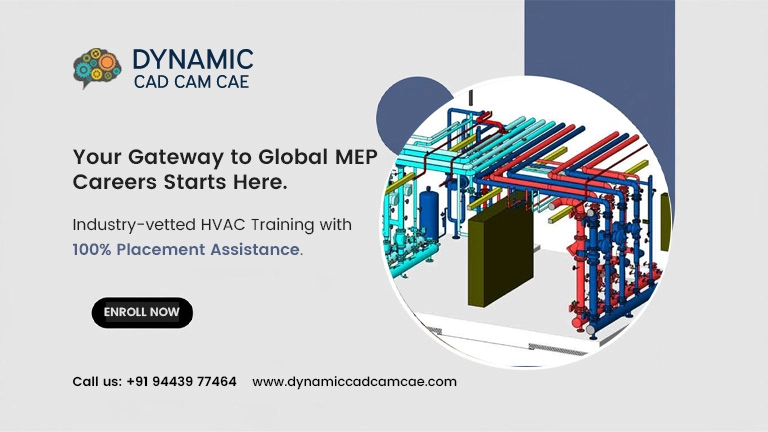
For decades, a Bachelor’s degree in Mechanical Engineering was considered the “golden ticket” to a stable career in the core industry. However, as we navigate through 2026, the landscape in Chennai’s industrial and construction sectors has undergone a seismic shift.
If you are a fresh graduate or a working professional in Tamil Nadu, you’ve likely noticed a frustrating trend: the fundamental thermodynamics and fluid mechanics taught in university are no longer enough to land a high-paying role in the MEP (Mechanical, Electrical, and Plumbing) sector. The “gap” between academic theory and industry reality has widened.
This is why HVAC design training in Chennai is no longer just an “extra” certificate—it is the bridge to a specialized, future-proof career.
The Hard Truth: Academic Theory vs. Industrial Reality
Standard mechanical engineering courses focus heavily on the “what” and “why” of machines. You learn the Rankine cycle and the laws of heat transfer, but you rarely learn how to apply them to a 40-story IT park in OMR or a multi-specialty hospital in Velachery.
1. The Software Deficit
In the professional world, manual calculations are a secondary check. The primary work happens in specialized software like Carrier HAP (Hourly Analysis Program) and Revit MEP. Most university labs stop at basic AutoCAD, leaving students unprepared for the BIM (Building Information Modeling) workflows that are now mandatory for Chennai’s green building projects.
2. Lack of Regulatory Knowledge
Designing a system isn’t just about cooling; it’s about compliance. Traditional degrees rarely cover the ASHRAE and ISHRAE standards or the latest Energy Conservation Building Codes (ECBC). Without understanding these local and international regulations, a mechanical engineer cannot legally sign off on a design.
3. The Shift to “Smart” Systems
2026 is the year of AI-integrated HVAC. Modern systems now use IoT sensors and variable refrigerant flow (VRF) technology. Specialized design courses teach you how to integrate these smart electronics with mechanical hardware—a multidisciplinary skill that a traditional degree simply doesn’t provide.
Why Choose Dynamic CAD CAM CAE for HVAC Design Training in Chennai?
When you decide to specialize, the institute you choose becomes your launchpad. Dynamic CAD CAM CAE has emerged as the premier destination for engineers looking to dominate the HVAC sector. Here is why:
- Practical, Project-Based Curriculum: We don’t do “chalk and talk.” Our training is rooted in real-world scenarios. Students at Dynamic CAD CAM CAE work on live architectural blueprints, performing heat load calculations and duct sizing for actual commercial projects.
- Mastery of Industry-Standard Tools: We bridge the software gap by providing expert-led training in Carrier HAP, Revit MEP, and AutoCAD HVAC. Our labs are equipped with the latest 2026 versions of these tools, ensuring you are “industry-ready” from day one.
- Mentorship from MEP Veterans: Our trainers aren’t just academics; we are seasoned consultants who have designed HVAC systems for major infrastructure in South India. We teach you the “tricks of the trade”—how to avoid clashes in BIM, how to optimize energy for LEED certification, and how to handle site-specific challenges.
100% Placement Assistance: Through our LinkedIn Placement Assistance Program (L-PAP), we connect our students with top-tier MEP consultancy firms and construction giants in Chennai. We don’t just give you a certificate; we give you a career path.
Take the Next Step in Your Engineering Career
The difference between a “job seeker” and a “specialist” is the willingness to bridge the gap. Don’t let your mechanical engineering degree sit idle. Equip yourself with the specialized skills that the 2026 industry demands.
Frequently Asked Questions (FAQ)
1. I am a fresh mechanical graduate. Can I start HVAC design training without any prior experience?
Absolutely. At Dynamic CAD CAM CAE, our course starts from the absolute fundamentals of psychometrics and heat transfer before moving into advanced software-assisted design.
2. Is there a high demand for HVAC designers in Chennai right now?
Yes. With Chennai’s rapid expansion as a Data Center and Global Capability Center (GCC) hub, every new building requires a sophisticated, energy-efficient HVAC system. This has created a massive demand for certified designers.
3. Does the course cover international standards like ASHRAE?
Yes, our curriculum is strictly aligned with ASHRAE (American Society of Heating, Refrigerating and Air-Conditioning Engineers) and ISHRAE (Indian Society) standards, making our graduates eligible for high-paying roles in the Middle East and beyond.
4. What is the average salary of a certified HVAC Design Engineer in 2026?
Entry-level certified designers in Chennai typically start between ₹3.5L to ₹5.5L per annum, while experienced professionals with BIM and Revit skills can command upwards of ₹12L+ in the senior consultancy space.
5. Are there weekend batches for working professionals? Yes, we offer flexible learning options, including intensive weekend batches and evening fast-track programs, specifically designed for engineers who want to upskill without leaving their current jobs.