
If you’re an architect, civil engineer, or draftsman who has spent years drawing in AutoCAD, you may have felt the ground shifting lately. Job listings increasingly ask for Revit and BIM skills, and firms that once ran entirely on 2D drawings are moving to something different. That shift is real, and it’s why revit training in chennai has become one of the smartest career moves for anyone in the building and construction industry right now.
At Dynamic CAD CAM CAE, we meet many professionals who are excellent at what they do but sense they need to update their toolkit. Here’s an honest look at why making the CAD-to-BIM leap is worth it — and what it involves.
CAD and BIM aren’t the same thing
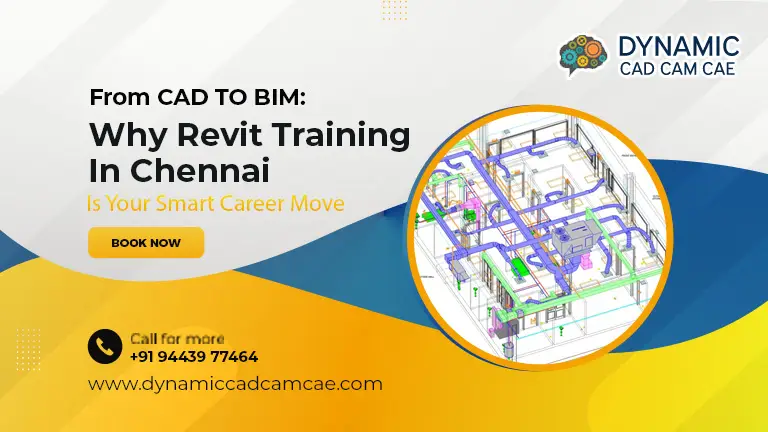
It’s a common misunderstanding that Revit is just a newer version of AutoCAD. It isn’t. CAD is essentially digital drawing — lines and shapes representing a building. BIM, or Building Information Modelling, is something bigger: you build an intelligent 3D model where every wall, door, and beam is a real object carrying information, and everything is connected.
Change a wall in a BIM model and the plans, elevations, and schedules update automatically. That connected intelligence is why the industry is moving to BIM, and why revit training in chennai focuses on a genuinely different way of working, not just new software buttons.
Why the industry has already decided
This isn’t a passing trend. Around the world, and increasingly in India, BIM is becoming the standard for serious construction projects — and in many places it’s a requirement for large or government work. Firms adopt it because it reduces errors, improves coordination between teams, and saves time and money across a project’s life.
For you, the takeaway is simple: the demand is shifting toward BIM-skilled professionals, and that shift is only accelerating. Completing revit training in chennai positions you on the right side of that change instead of watching opportunities pass to those who upskilled.
What you’ll actually learn
Good training takes you from the ground up — the Revit interface and core concepts, then modelling walls, floors, roofs, doors, and windows to create a real building model. You’ll learn to generate plans, sections, elevations, and 3D views directly from that model, and to produce the schedules and documentation a project actually needs.
Beyond the mechanics, quality revit training in chennai teaches you to think in BIM — to understand why the model is built the way it is and how teams collaborate within it. That mindset is what separates someone who can click around Revit from someone who can genuinely deliver on a BIM project.
The career payoff
The practical upside is strong. BIM skills open doors to roles like BIM modeller, BIM coordinator, and Revit specialist, and they often command better pay than pure 2D drafting because the skill is more valuable and less common. For architects and civil engineers, it makes you far more employable and useful on modern projects.
There’s a defensive benefit too. As BIM becomes standard, professionals who only know 2D CAD risk being left behind. Investing in revit training in chennai is partly about seizing new opportunities and partly about future-proofing the career you’ve already built.
Who should make the move
Architects, civil and structural engineers, draftsmen, and construction professionals all stand to gain — as do students who want to enter the field already equipped with what employers want. If you have a CAD background, you’ll find the transition very doable with proper guidance.
The move from CAD to BIM is one of those career decisions that looks obvious in hindsight. The industry has chosen its direction, and the professionals who adapt early tend to benefit most. With focused revit training in chennai from a place like Dynamic CAD CAM CAE, you can make that leap confidently and step into the modern construction world with skills that are genuinely in demand.
Frequently Asked Questions
1. What is the difference between CAD and BIM?
CAD is essentially digital 2D drawing, while BIM builds an intelligent 3D model where each element carries information and everything is linked. Change one part of a BIM model and related drawings and schedules update automatically, which is why the industry is moving to it.
2. Who should take Revit training in Chennai?
Architects, civil and structural engineers, draftsmen, and construction professionals benefit most, along with students wanting to enter the field job-ready. If you have a CAD background, the transition is very manageable with proper guidance.
3. What will I learn in the course?
You’ll learn the Revit interface and BIM concepts, how to model walls, floors, roofs and openings, how to generate plans, sections, elevations and 3D views, and how to produce schedules and documentation. Good training also teaches the BIM mindset and team collaboration.
4. What jobs can Revit and BIM skills lead to?
Roles include BIM modeller, BIM coordinator, and Revit specialist. Because BIM skills are valuable and less common than basic drafting, they often command better pay and make you more employable on modern construction projects.
5. Is BIM really replacing traditional CAD?
BIM is becoming the standard for serious construction work and is often required on large or government projects. Traditional 2D CAD still has uses, but professionals who add BIM skills are far better positioned as the industry shifts.