
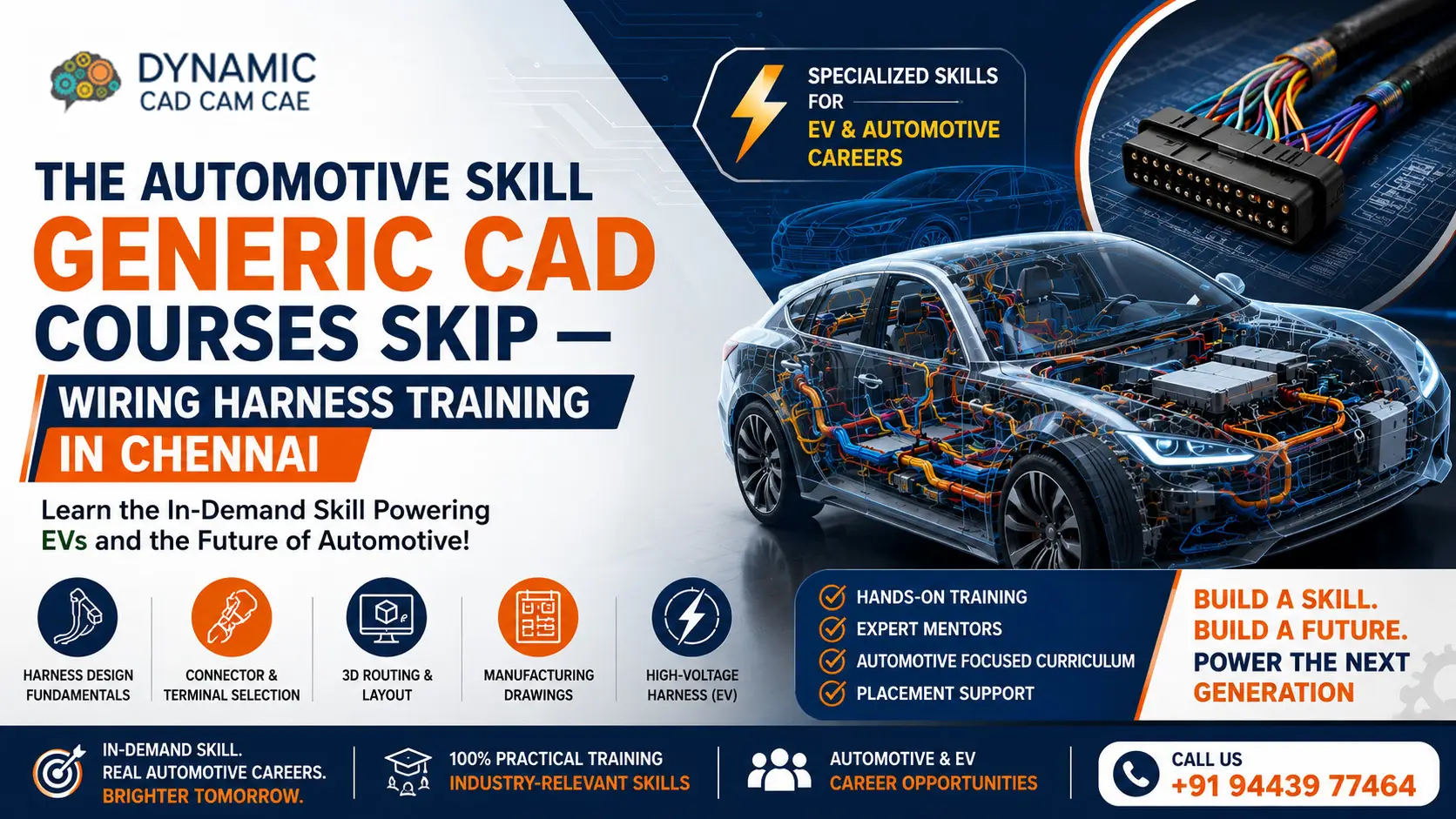
Here’s a small, uncomfortable truth about most CAD courses: thousands of people finish them every year, learn the same AutoCAD commands, and then compete for the same handful of low-paying drafting jobs. Everyone learns the same thing, so nobody stands out. If you want a different result, you need a different skill. A wiring harness course in Chennai is one of those skills — narrow, in demand, and pointing straight at where the automotive industry is actually heading.
And where it’s heading is electric.
Why wiring harness suddenly matters more than ever
Every vehicle has always needed a wiring harness — the organised bundle of wires, connectors, and terminals that carries power and signals to every component. But the electric-vehicle shift has turned this from a background job into a genuinely critical one.
EVs are packed with electronics. Battery management, high-voltage distribution, sensors, control units, charging systems — all of it needs to be wired safely, efficiently, and to tight weight and space constraints. High-voltage harness design in particular is a specialised discipline that traditional CAD training never even touches. As India’s EV manufacturing ramps up, the number of engineers who can actually design these harnesses hasn’t kept pace.
That’s the gap a focused wiring harness course in Chennai is built to fill. And at Dynamic CAD CAM CAE, it’s taught as the automotive-career skill it really is — not a footnote in a general CAD syllabus.
What a generic CAD course won’t give you
A standard AutoCAD or general CAD course teaches you to draw. That’s useful, but it’s also common. It doesn’t teach you how a harness is routed through a chassis, how to select connectors and terminals, how to build a flattened harness drawing for manufacturing, or how to handle the electrical logic behind the bundle.
Those are the exact things a harness design engineer does every day — and the exact things employers can’t find enough people to do. When you can talk about connector selection, wire gauges, splice points, and manufacturing-ready formboard drawings, you’re no longer one of a thousand identical CAD resumes. You’re a specialist.
That specialisation is precisely why a targeted wiring harness course in Chennai beats a generic one for anyone eyeing automotive or EV work.
Why Chennai is the smart place to learn this
Chennai’s nickname — the Detroit of India — isn’t marketing fluff. The city sits at the centre of a huge automotive and auto-component manufacturing base, with OEMs, tier-one suppliers, and a growing EV supply chain all clustered nearby. Harness manufacturing and design work naturally follows that ecosystem.
Learning where the industry operates means the skills you build line up with real local hiring. Dynamic CAD CAM CAE trains within that environment, which is a practical edge when you start applying — you’re learning what the companies down the road actually need.
What you’ll learn in the course
A proper wiring harness course in Chennai should take you well beyond drawing lines:
- The fundamentals of automotive electrical systems and harness architecture
- Reading and interpreting wiring schematics and diagrams
- Connector, terminal, and wire selection for real applications
- 3D routing of harnesses through a vehicle model
- Flattening harnesses into manufacturing-ready formboard drawings
- An introduction to high-voltage harness considerations for EVs
Every module maps to a task a harness engineer performs on the job. That’s the difference between learning software and learning a profession.
The EV career angle
This is where it gets exciting. India’s push toward electric mobility isn’t a future story — it’s happening now, with manufacturing investment, new plants, and a scramble for skilled people. High-voltage systems are central to every EV, and harness design is a core part of making them safe and efficient.
The engineers who understand EV harness design are entering the field early, before the skill becomes crowded. That timing matters. Getting in now, through a focused wiring harness course in Chennai, positions you ahead of the wave rather than behind it — and early specialists in a growing field tend to do very well.
Compare that to finishing a generic CAD course and joining the long queue for ordinary drafting roles. Same effort, completely different outcome.
Why learners choose Dynamic CAD CAM CAE
Dynamic CAD CAM CAE built its reputation on the specialised, career-focused courses that most local centres skip — including automotive and EV-oriented training. The wiring harness course here is hands-on and taught with real automotive workflows in mind, not as a generic add-on.
You also get flexibility with online and offline batches, mentors who understand the industry, and placement support that points you toward automotive and EV companies genuinely hiring. For students and working professionals trying to break into automotive design, that focus is exactly what turns a course into a career move.
The bottom line
If everyone around you is doing the same AutoCAD course, doing one more of them won’t change your prospects. Specialising will. Wiring harness design is a specific, in-demand skill that generic CAD training ignores — and it points directly at the fastest-growing part of the automotive world.
Learn it properly, in India’s automotive capital, from people who understand where EVs are going, and you give yourself a real edge instead of another lookalike certificate. That’s the whole case for a wiring harness course in Chennai at Dynamic CAD CAM CAE — a narrower path, but a far better-paying and more interesting one.
Frequently Asked Questions
1. Who is the wiring harness course at Dynamic CAD CAM CAE meant for?
It suits mechanical, automobile, and electrical engineering students and graduates aiming for automotive or EV careers. The wiring harness course in Chennai at Dynamic CAD CAM CAE welcomes both freshers and working professionals.
2. Do I need an electrical background to join?
Not necessarily. The course begins with automotive electrical fundamentals before moving into design, so candidates from mechanical and automobile backgrounds can follow along comfortably at Dynamic CAD CAM CAE.
3. How is this different from a normal CAD course?
A generic CAD course teaches drawing. A wiring harness course in Chennai teaches harness architecture, connector selection, routing, and manufacturing-ready drawings — the specialised skills automotive and EV employers actually hire for.
4. What jobs can I get after this course?
Roles such as wiring harness design engineer, harness development engineer, and electrical design engineer with automotive OEMs, tier-one suppliers, and EV companies.
5. Does Dynamic CAD CAM CAE provide placement support?
Yes. Dynamic CAD CAM CAE offers hands-on training, flexible online and offline batches, and placement assistance directed toward automotive and EV companies actively recruiting.