
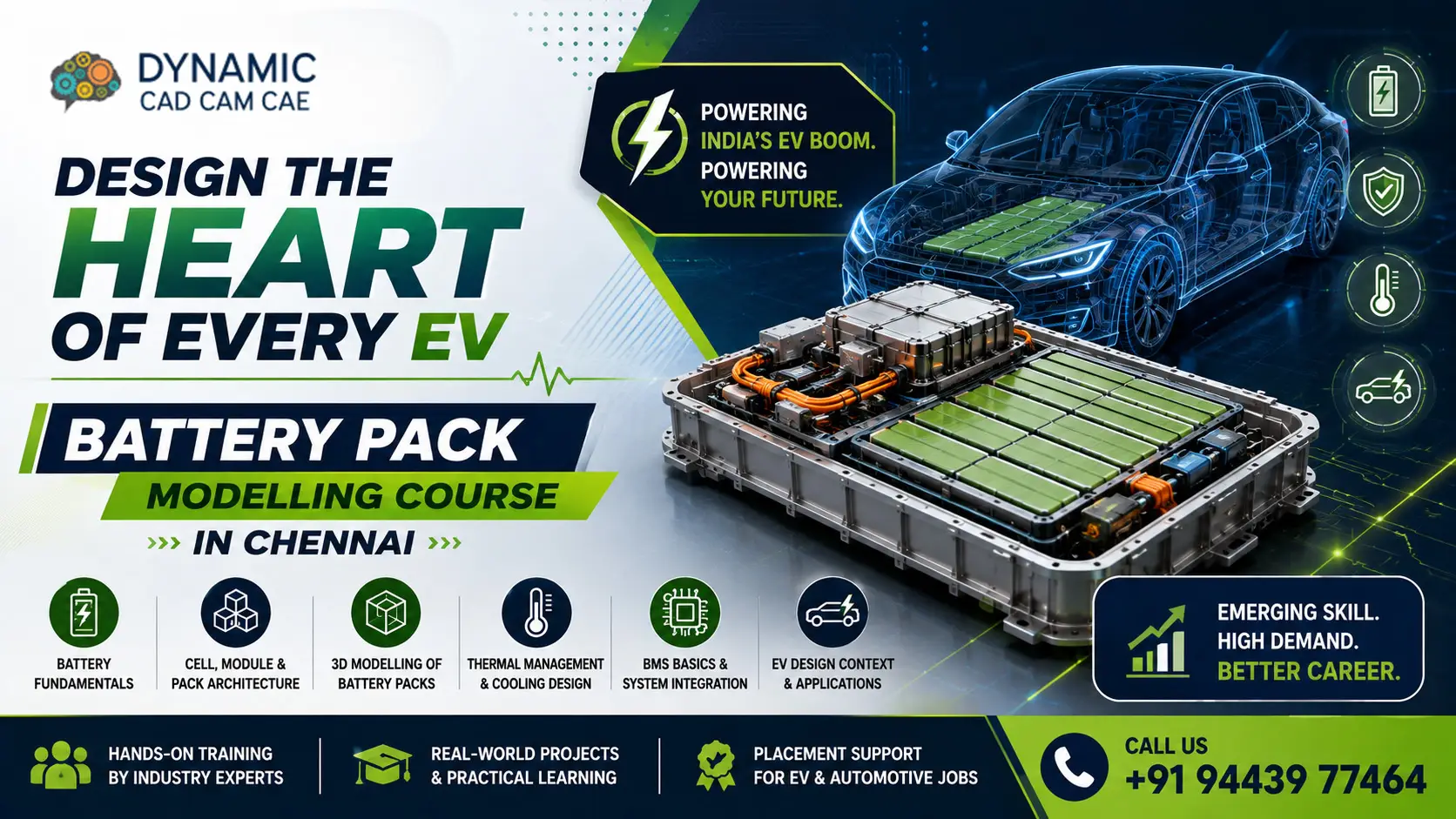
Every electric vehicle has one component that everything else revolves around. Not the motor, not the software — the battery pack. It decides the range, the cost, the safety, and the weight of the entire vehicle. It’s the single most valuable and most engineered part of an EV. And right now, India is building millions of them while quietly struggling to find enough engineers who know how to design them.
That mismatch is an opportunity. A battery pack modelling course in Chennai puts you exactly where the demand is racing ahead of the talent — the best possible place to build a career.
Why battery packs are the skill of the decade
Here’s what makes battery pack design different from ordinary mechanical work. It’s genuinely multi-disciplinary. A good pack designer thinks about cell selection and arrangement, mechanical enclosure and structure, thermal management to stop cells overheating, and the safety systems that keep the whole thing from becoming a hazard. It sits at the crossroads of mechanical, thermal, and electrical engineering.
That complexity is exactly why the skill is scarce. Traditional courses don’t teach it. Most engineering graduates have never modelled a module, never thought about cell-to-pack packaging, never simulated how heat moves through an array of cells. So when EV companies go looking for battery design talent, the pool is shallow — and getting into it early is a serious advantage.
A focused battery pack modelling course in Chennai exists to build that scarce skill deliberately. At Dynamic CAD CAM CAE, it’s taught as the emerging EV specialisation it is, not buried inside a generic syllabus.
India’s EV boom is not a someday story
Sometimes “future opportunity” is a polite way of saying “not yet.” Not here. India’s electric-vehicle sector is expanding right now — new manufacturing, government push, rapidly growing two-wheeler and passenger EV adoption, and a domestic battery supply chain being built almost from scratch.
That growth needs people who can design the packs, model the modules, plan the thermal behaviour, and think through EV architecture. The demand is arriving faster than colleges can produce specialists. Which means the engineers who train now — before the field gets crowded — walk into a market that’s actively short of them.
Timing is everything in a new field, and a battery pack modelling course in Chennai is a way to get in ahead of the crowd rather than after it.
What you’ll actually learn
A serious course in this space should go well beyond theory. At a strong battery pack modelling course in Chennai, you can expect to work through:
- Battery fundamentals — cell types, chemistries, and characteristics
- Cell, module, and pack architecture and packaging
- 3D modelling of battery pack structures and enclosures
- The basics of thermal management and cooling strategies
- An introduction to battery management systems (BMS) concepts
- EV design context — how the pack fits the whole vehicle
The goal is that you leave able to reason about a pack the way an EV design team does, not just recite definitions. That practical grounding is what makes the difference in an interview.
Why Chennai, and why now
Chennai’s deep automotive base is quietly reinventing itself around electric mobility. The same ecosystem of OEMs, component makers, and engineering-services firms that made the city India’s automotive capital is now investing in EV development. That means EV design work — including battery-related roles — is increasingly being created right here.
Training inside that ecosystem is a practical advantage. Dynamic CAD CAM CAE sits within it, so the skills you build through a battery pack modelling course in Chennai align with the roles local companies and their hiring partners are creating as the EV shift accelerates.
The career case, honestly
Let’s be straight about it. Battery and EV design is a young field in India, which cuts both ways. You won’t find thousands of identical job postings the way you do for AutoCAD drafting. But you also won’t be competing against thousands of identical candidates. The roles that do exist are meaningful, better paid, and growing in number every year.
Early specialists in emerging fields tend to build outsized careers, precisely because they were there before it got crowded. Getting battery pack and EV design skills now, through a dedicated battery pack modelling course in Chennai, is a bet on where the industry is clearly going — and it’s a bet with the odds in your favour.
Why Dynamic CAD CAM CAE
Most training centres are still teaching the same handful of legacy CAD tools. Dynamic CAD CAM CAE deliberately covers emerging, high-value areas that others ignore — including EV technology, battery pack modelling, and BMS fundamentals — because that’s where tomorrow’s jobs are being created.
The training here is hands-on and mentor-led, with online and offline batches to suit students and working professionals. Placement support points you toward the EV and automotive companies building out their engineering teams. For anyone who wants to ride India’s EV wave rather than watch it, that focus is exactly the head start that matters.
The bottom line
The EV boom in India is real, it’s happening now, and it runs on battery packs. The engineers who understand how to design them are scarce today and will be sought after tomorrow. That’s a rare, clear window.
Learn the skill properly, in India’s automotive capital, from people focused on where the industry is heading, and you step into the EV story early — as a specialist, not a spectator. That’s the entire promise of a battery pack modelling course in Chennai at Dynamic CAD CAM CAE.
Frequently Asked Questions
1. Who should take the battery pack modelling course at Dynamic CAD CAM CAE?
Mechanical, automobile, electrical, and mechatronics engineering students and graduates aiming for EV careers. The battery pack modelling course in Chennai at Dynamic CAD CAM CAE suits freshers and working professionals looking to enter the EV field.
2. Do I need prior EV knowledge to join?
No. The course starts with battery and EV fundamentals before moving into modelling and design, so you can begin without an EV background at Dynamic CAD CAM CAE.
3. What career roles does this course lead to?
Roles such as battery pack design engineer, EV design engineer, and battery development engineer with EV manufacturers, startups, and automotive engineering-services companies.
4. Why learn battery pack modelling instead of a general CAD course?
Because it’s a scarce, emerging skill tied directly to India’s EV boom. A battery pack modelling course in Chennai points at growing, better-paid roles rather than the crowded market for generic drafting.
5. Does Dynamic CAD CAM CAE offer placement support and flexible batches?
Yes. Dynamic CAD CAM CAE provides hands-on training, online and offline batches, and placement assistance directed toward EV and automotive companies actively building their engineering teams.